

Join
Programs
About
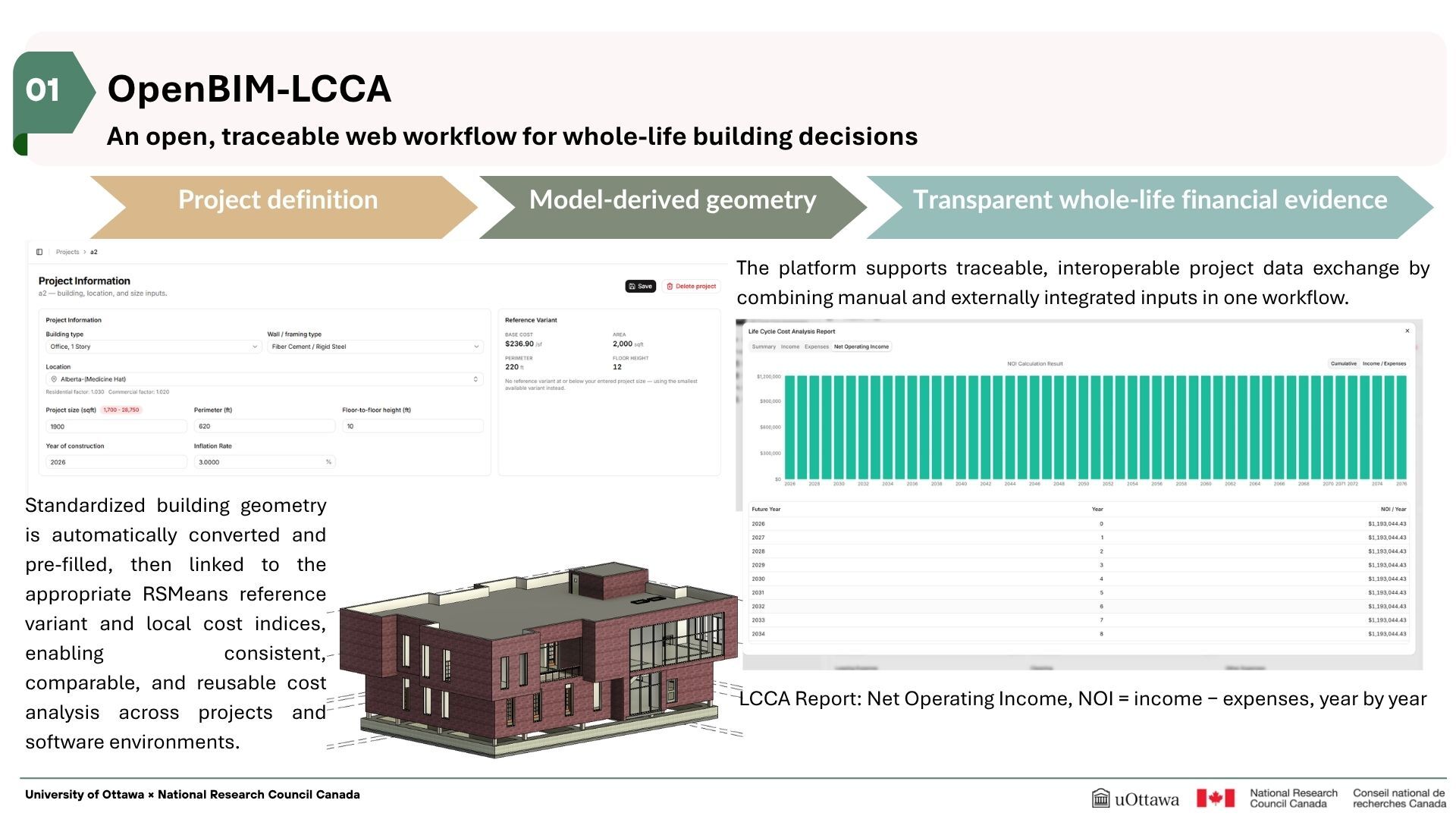


Open Building Information Modeling–Life-Cycle Cost Analysis (OpenBIM-LCCA) transforms interoperable building data into transparent capital-cost and whole-life financial assessments. It connects Industry Foundation Classes (IFC)-derived geometry with RSMeans estimates, present-value analysis, carbon pricing, sensitivity testing and project comparison, helping teams evaluate alternatives earlier and without vendor dependence.

Building teams make long-term investment decisions using information fragmented across BIM authoring tools, estimating databases, spreadsheets, and specialist sustainability applications. Geometry and quantities are repeatedly re-entered; capital cost, carbon cost, operating expenses, maintenance, repair, and replacement are often assessed at different times; and assumptions become difficult to trace. The result is slow option testing, inconsistent calculations, and limited confidence in comparisons.
The technical challenge was therefore not simply to calculate life-cycle cost. It was to create a connected, auditable path from an open building information source to a decision-ready financial result. The solution had to accept both manually entered projects and model-derived inputs, select an appropriate RSMeans reference variant, adjust the estimate for project-specific size, perimeter, floor height, location, and time, preserve a UniFormat cost breakdown, and combine capital, carbon, income, operating, and periodic asset costs within a single present-value model. It also needed to help users understand which assumptions drive the result and compare alternatives on an equivalent basis.
OpenBIM-LCCA creates one traceable web workflow from project information to option selection. A project can be created manually or received from the companion NBLA/openBIM workflow, which supplies model-derived area, perimeter and floor height. The source remains visible, and a project can be duplicated to create an independent alternative.
For capital cost, the platform selects the RSMeans reference size bracket appropriate to the project and transparently adjusts the base cost per square foot for five variables: size, perimeter, floor-to-floor height, location and time. It then reports direct costs through the UniFormat hierarchy and reconciles line-item quantities, cost per square foot and totals. Users add land, indirect costs and monetized carbon to obtain total capital cost.
For whole-life analysis, users define the study period and discount rate, income, salvage value, energy and operating expenses. RSMeans task categories supply maintenance, minor repair, major repair and replacement costs; irregular costs are converted to equivalent annual values and all cash flows are discounted to present value. The platform calculates net present value (NPV) and savings-to-investment ratio (SIR), provides year-by-year income, expense, and net operating income reports, varies key parameters for sensitivity analysis, and compares several projects side by side. This replaces disconnected files with a consistent and reviewable decision chain.


