

Join
Programs
About
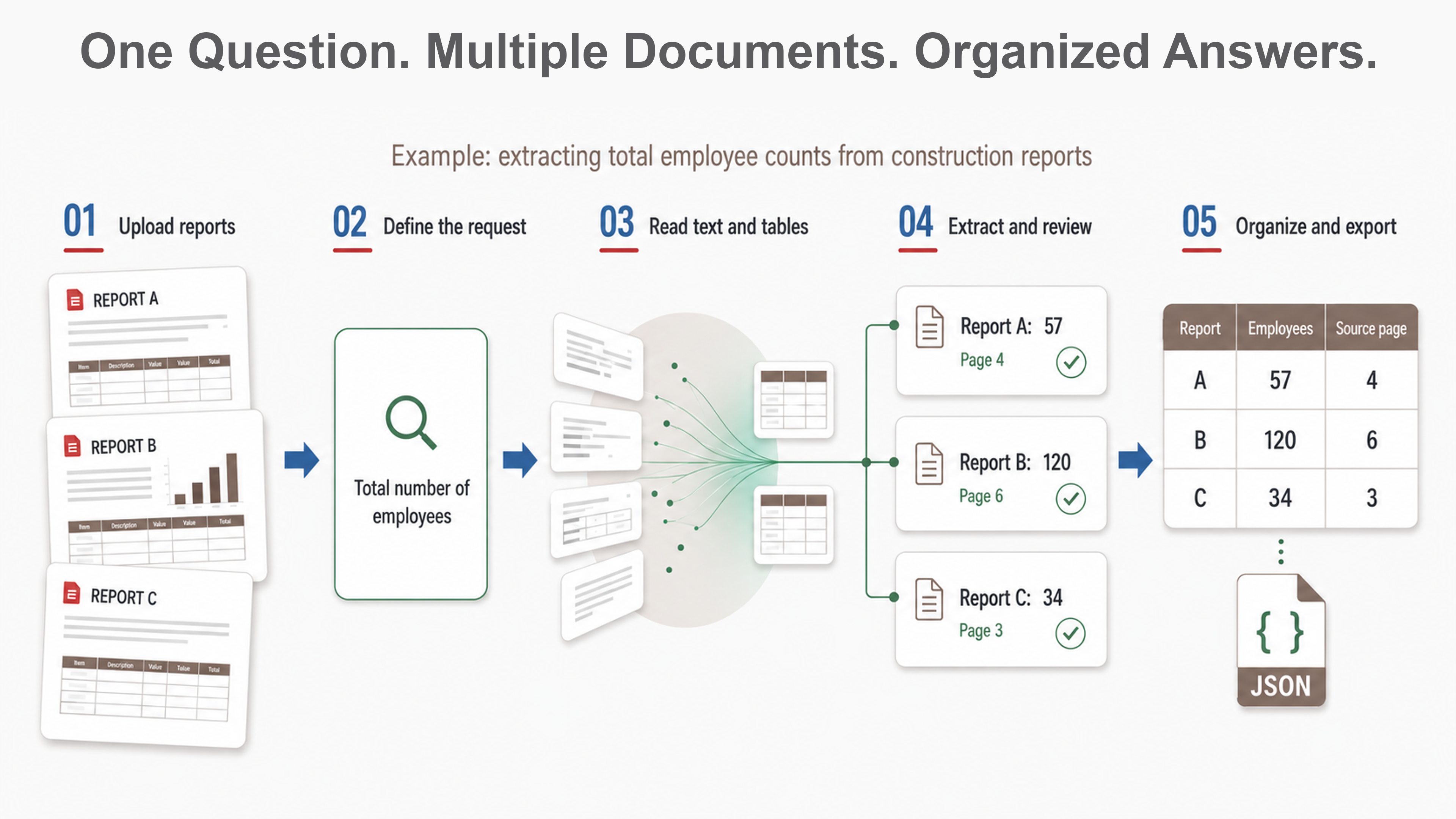


Important details often get buried in lengthy construction documents. This research develops an AI assistant that extracts requested information, organizes the results, and links answers to their sources so users can check them easily. This helps professionals compare projects, identify trends, and make better decisions.

Construction professionals need to find many kinds of information in project documents, depending on the task at hand. For example, they may be looking for a project’s cost, completion date, or use of BIM. Finding these details can mean searching a lengthy report, scanning several tables, and copying answers into a spreadsheet. Repeating this across dozens of differently organized documents can turn a simple question into hours of work.
This manual process takes time away from analysis and decision-making. Important details can be missed, copied incorrectly, or recorded in different ways. When a colleague asks where a number came from, the search often starts again.
Confidentiality adds another challenge. Construction documents may contain sensitive client information, project costs, and internal business details. Sending these documents to external AI services may conflict with client agreements or company policies, limiting the tools teams can use.
The challenge is therefore to make information extraction easier while keeping results traceable and sensitive documents under organizational control. This research addresses that need through an AI assistant that extracts requested information, organizes the results, and links answers to supporting sources for human review. Local processing can reduce external data exposure by keeping documents within the organization’s controlled environment.
The practical goal is to reduce repetitive searching and copying so professionals can focus on understanding and using the information.
The AI assistant helps construction professionals move from searching documents to reviewing answers. Users upload documents and specify the information they need. The system combines document processing with AI to locate relevant content, interpret it in context, and organize the extracted information into a consistent format.
This addresses a key difficulty of manual extraction: the same information can appear under different headings, within tables, or in sentences that use different wording. The assistant uses context to identify relevant details rather than relying only on exact keyword matches.
For example, a coordinator preparing a submittal log must work through project specifications to identify required shop drawings, product data, samples, and test reports. The assistant could help compile these requirements into a draft list with source references, giving the coordinator a starting point to check instead of collecting every entry manually.
Each extracted answer is linked to supporting source information. Users can check the relevant passage without searching the entire document again. Human review remains essential before the information is used for project decisions.
Organized outputs also make it easier to compare documents and prepare data for analysis. When document processing and AI extraction run locally, sensitive content can remain within the organization’s own systems.
Together, these functions simplify finding, recording, and checking information while keeping users in control of the final results.


