

Join
Programs
About
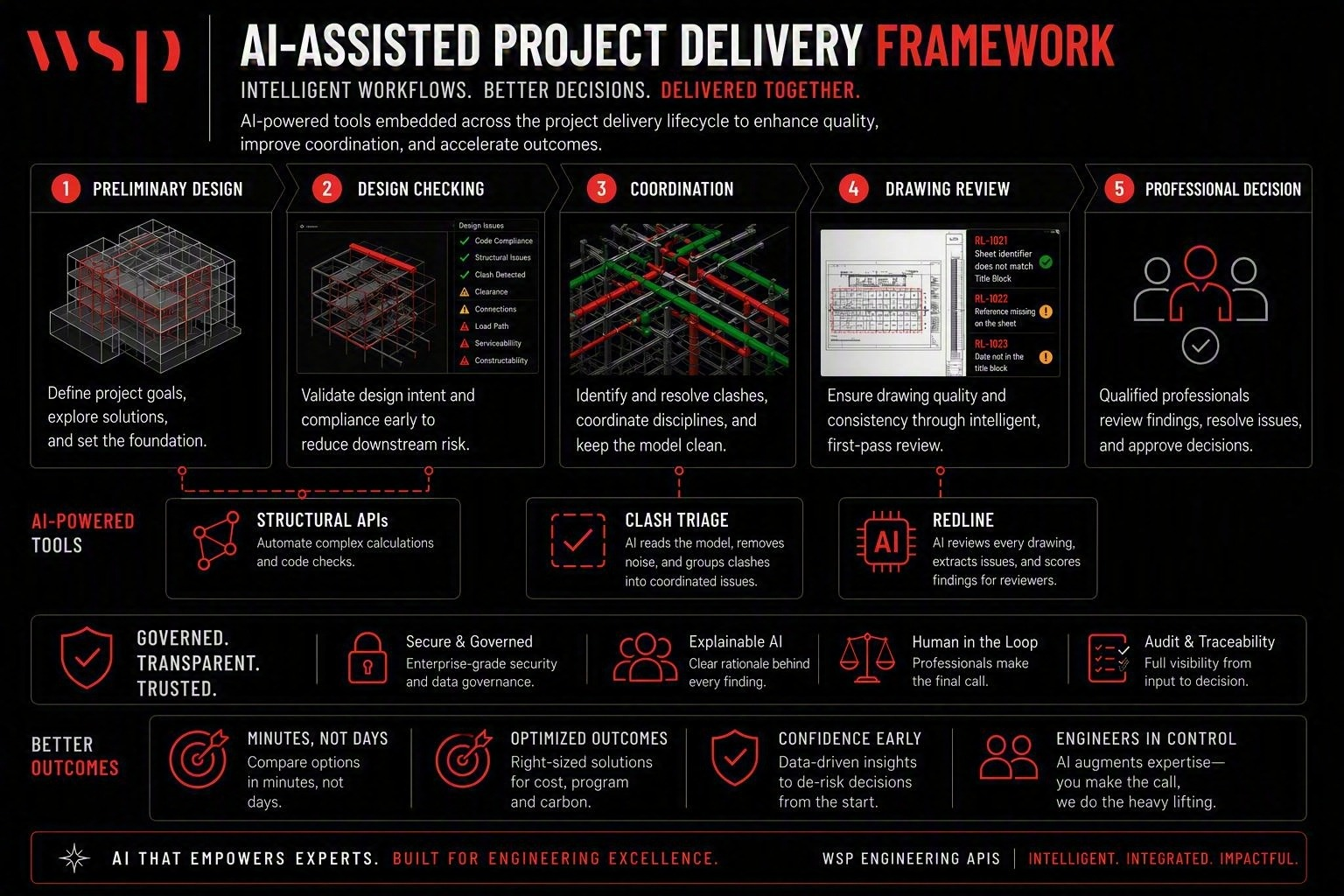


AI should not replace engineering judgment; it should amplify it. WSP is embedding responsible AI throughout project delivery to support preliminary design, prioritize coordination issues, and strengthen drawing reviews. By identifying potential risks earlier and focusing attention where expertise matters most, the framework helps qualified professionals make better-informed engineering decisions.

Building project teams must interpret and verify large volumes of calculations, model information, coordination issues, and drawing content throughout project delivery. These activities require professional judgment, but they also include repetitive and high-volume tasks that consume time and can make quality processes difficult to apply consistently across projects.
During preliminary design, engineering methods may be dispersed across spreadsheets, scripts, reference documents, and individual expertise. This makes validated approaches difficult to reuse through different applications and teams.
During multidisciplinary coordination, model-checking platforms can generate extensive clash results. Identifying duplicates, grouping related issues, establishing ownership, and determining which clashes require attention can demand substantial manual effort before technical coordination even begins.
During drawing production and review, engineers and peer reviewers must identify both technical concerns and repeatable documentation issues, including missing references, inconsistent schedules, overlapping information, and coordination discrepancies. When basic concerns are discovered late, review cycles can become focused on corrections rather than higher-value technical judgment.
The challenge was not to automate engineering responsibility. It was to determine where governed computation and artificial intelligence could support project teams without creating an opaque or autonomous design process.
WSP therefore began developing an integrated approach that combines deterministic engineering services, AI-assisted issue interpretation, explainable drawing analysis, and human review. The objective is to move quality activities earlier in project delivery, support more consistent processes, and allow professionals to focus attention where experience and judgment create the greatest value.
WSP developed an AI-assisted project delivery framework that embeds support at three connected stages of the engineering workflow: preliminary design, multidisciplinary coordination, and deliverable review.
Structural APIs support design development and checking. Repeatable engineering calculations developed by WSP engineer are converted into documented computational services with defined inputs and outputs. Engineers and approved applications (including governed AI agents and chats) can use these services for preliminary design and verification, while future AI interfaces can further orchestrate the workflow without relying on a language model to invent engineering calculations. Prototype documentation includes interactive calculation examples, an API catalogue, and reference material describing available calculations, required inputs, and returned results.
Clash Triage supports multidisciplinary coordination. The AI-assisted platform groups, prioritizes, and streamlines issues produced through ACC Model Coordination. It is intended to help teams convert high-volume clash results into information that is more digestible and actionable, while project professionals determine the required coordination response.
Redline supports drawing QA/QC. The tool combines deterministic checks with AI-assisted analysis to identify potential drawing concerns and present transparent findings, including supporting evidence, confidence information, rule versioning, and review coverage. It provides an initial set of eyes before formal review rather than replacing peer review or engineering judgment.
Together, these capabilities shift assurance from a final checkpoint toward a continuous process throughout design and coordination. AI handles information volume and repetitive analysis; governed services perform defined calculations; engineers validate findings and make decisions.


