


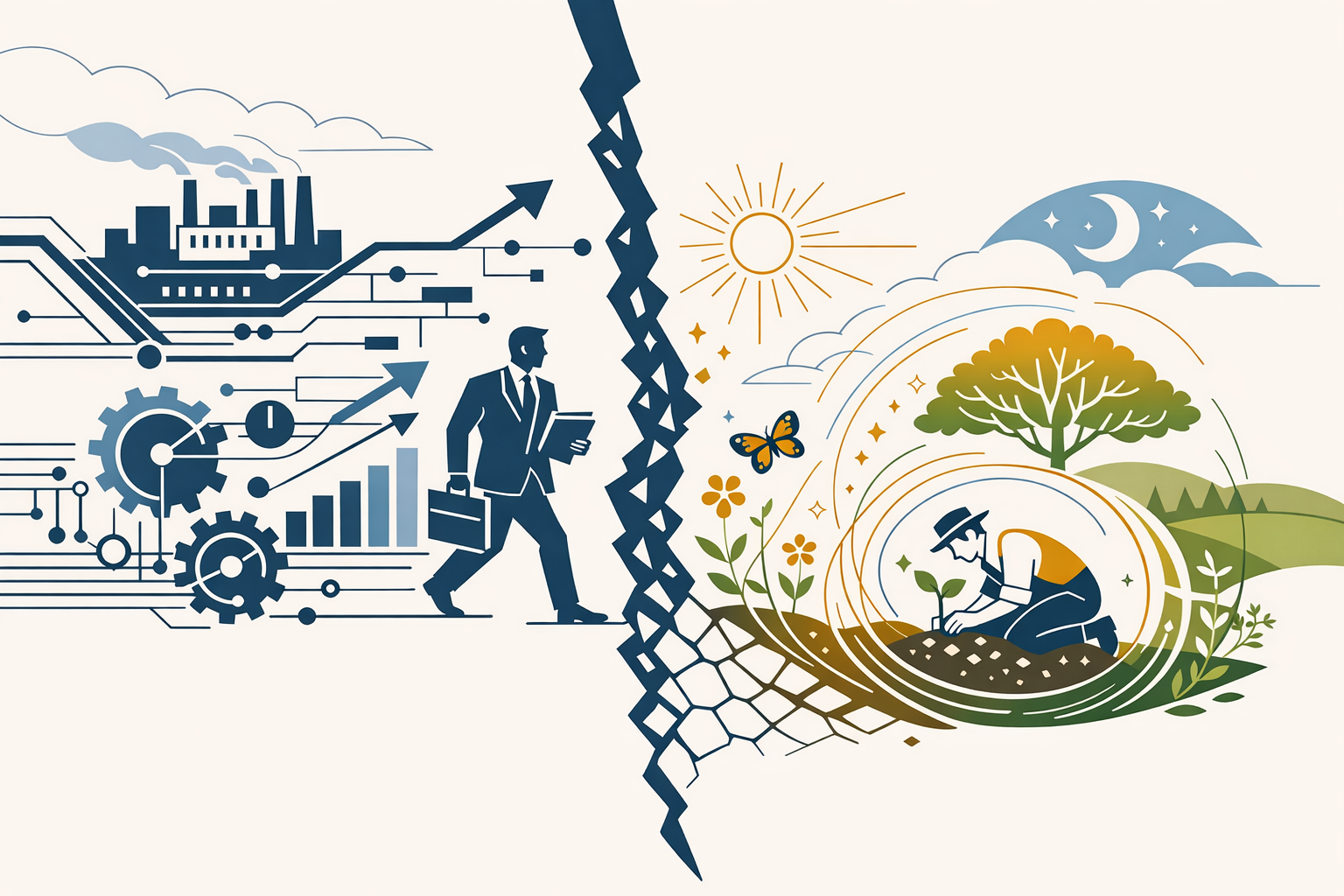
Sustainability Meets Productivity: The Rise of Digital Efficiency and how it Affects Leadership, Work, and the Industry
By Dr. Reva Bond, Founder, Halcyon Homesteading
The opportunity for digital efficiency and innovation is a promise that the tech industry has offered the world, but has largely failed to deliver. Our current definition of productivity is in direct opposition to our popular understanding of sustainability, leading to the term greenwashing to describe this shortfall. To be more productive, or, digitally efficient for example, we need to extract more resources. Sustainability and productivity will never “meet”. Leaders across every industry face a paradoxical conundrum. For better or worse, the building industry is one of the most visible and arguably, under high pressure to close this gap, to get it right.
Building leaders, therefore, have a bold opportunity in front of them. Shift focus away from the limiting iron triangle of project management (scope, time, cost) and towards limitless possibility with the triskelion of regeneration (place, space, grace). The time to stop bedazzling progress is now. We need leaders who are ready to enable honest dialogue that reveals the deterioration in disguise. Continuing to adorn projects with embellishments is contributing a false narrative that appeases shareholders in the short term and damages the future of humanity in the long term. If we can’t get real about the starting point, progress will remain an illusion.
The current pathway we are running down has us chasing productivity, efficiency, and the endless growth curve—all of which are degrading our current quality of leadership, work, and life. Every industry has fallen into this deep trap, including the building industry, blocking our view, failing to see what is right in front of us. Because human capital, manhours, labour is entered on a spreadsheet as a cost, we tricked ourselves into believing we could control it. This control has directly contributed to increased stress levels, increased anxiety, increased depression, increased addictions, high turnover, labour shortages, an unshakeable reputational stigma, low engagement, and low morale. If we want to ensure a future where quality of life improves or at least stops degrading, becomes truly sustainable, then we need to stop chasing false promises and get authentic with reality.
There are few aspects of our reality that man did not construct and therefore cannot control. The following form the foundation of the triskelion, a framework to guide regenerative work in the building industry.
People. Grace.
The land. Place.
Cycles and seasons. Space.
There is a term in the Complexity Leadership Theory of academic literature called “adaptive space”. A qualitative research study I conducted in 2022 sought to expand our understanding of this elusive and poorly understood concept to provide leaders with practical knowledge to foster innovation, collaboration, and inclusion in project teams and in their organizations. Because of my lived work experience in the building industry, I was looking for physical attributes that would help us build and shape environments that prioritized adaptive space. If I knew what it looked like, then designing for it would be straightforward. What the research identified surprised me.
Adaptive space is not blue walls or pink walls. Adaptive space is not leather couches or bean bag chairs. Adaptive space isn’t transparent glass doors or open concept offices. Adaptive space is …time. And more specifically, the time to revisit conversations where small or big decisions were made, and the time to invite missing voices into those conversations. Adaptive space is the explicit permission to question a decision and re-hash the decision with new voices that are empowered to share their unique lived experience. Adaptive space breaks the linearity of traditional project management communication channels. Adaptive space provides time for iteration, cycles, and evolution.
Adaptive space slows down the information gathering phase, widens the lens on who is at the table, and fosters emergence, which births innovation.
Adaptive space goes beyond continuous improvement. Incremental changes inherent in a continuous improvement model are still chasing productivity and efficiency. Adaptive space allows for emergence, innovation, and regeneration to blaze a new path; 2026 is the year of the fire horse after all. Space, adaptive space, is the first spiral of the triskelion.
But more surprising, and even disheartening, is the resistance that adaptive space continues to receive. Our reluctance, our ignorance in accepting what is required for leaders and followers to contribute in meaningful ways to creating adaptive space, is a barrier to regenerative innovation. Upon reflection, I see that adaptive space does not and cannot exist in the current mechanical paradigm of project management.
If this is true, adaptive space cannot exist in our 300-year-old mechanical paradigm, a brave and wise leader may decide to look to the past to find a plausible answer to guide our future. Not too long ago, before humans constructed capitalism, GDP, the steam engine, and wi-fi, we operated within an ecological paradigm. In the 1800’s, arguably a transitional century where both paradigms still operated with significant presence, 90% of the population was responsible for growing their own food. Today, only 7% of the population grows their own food – a generous estimate, based on global data. Growing your own food is now seen as two extremes. Either an extravagant luxury that few have the time for or an absolute survival necessity for poor peasants. Both labels are equally true and false. Neither label benefits from a rise in digital efficiency. Divisiveness serves the master of chaos, the antidote to uncertainty. Uncertainty has always been present.
The building industry has long had a relationship with place. We build for community needs, taking a holistic approach that considers social, historical, cultural, economic, and environmental aspects in an effort to create sustainable outcomes. However, in application the iron triangle is an economic model that prioritizes costs as the ultimate driver for change. Sacrificing and degrading the importance of the environment. A relationship with the soil, with nature, with sustenance, with place, is the second spiral of the triskelion.
The third spiral is grace, the relationship we have with ourselves. The addiction epidemic, the mental health crisis—you don’t need to look far to resolve that this relationship is suffering.
The three spirals intersect: grace, space, and place, to form the triskelion of regeneration. The triskelion is not to be controlled. It provides a way to identify uncertainty and have honest dialogue, bringing into awareness and work with it, not against it. The triskelion is a system of entangled, uncontrollable, uncertain variables that form the foundation of regenerative building. It operates in the ecological paradigm, silently, invisibly, regardless of our continued ignorance or our level of acceptance. If we decide to be brave, it can operate more visibly in our organizations, in the boardroom and on our job sites, guiding a healthier future.
A fair observation is that the promise of digital efficiency is contributing to divisiveness within organizations more often than it is contributing to healthy competiveness between organizations. When the divisiveness inside an organization grows everything becomes more difficult and any gains in productivity are swept away by the increase in effort required to sell the idea, change direction, and maintain healthy working relationships. Work gets a whole lot more complex, messy even. And messy is expensive. Especially when you don’t have the skills to operate effectively in that mess.
You may be thinking, “not in my company, everyone supports the changes put forward”. I want you to ask yourself: how often does a project meeting erupt with healthy debate? Not as much as it used to, that’s for certain. Our obsession with productivity has unintentionally muted innovation. Your next big invention or project advancement doesn’t exist with the adoption of a digital tool, it is sitting right in front of you, in the silence.


