



Orchestrating Complexity: A Holistic Digital Ecosystem for Modern Construction
From Fragmented Tools to Integrated Intelligence
As construction projects grow in scale and complexity, the industry faces increasing pressure to adopt digital technologies that improve productivity, safety, and predictability. Yet the proliferation of construction technologies—often siloed, vendor-specific, and poorly integrated—has made meaningful digital transformation difficult to achieve. EllisDon has responded by developing a holistic digital ecosystem that prioritizes interoperability, early validation, and outcome-driven integration. Rather than treating digital tools as isolated solutions, EllisDon’s approach connects models, site data, analytics, and workflows into a cohesive environment that enables proactive decision-making across the project lifecycle. This article outlines the challenges driving this approach, the ecosystem’s architecture, and its demonstrated impacts on project delivery, economic performance, and broader industry advancement.
The Digital Paradox in Construction Delivery
Construction today operates within a paradox. On one hand, the industry is experiencing unprecedented innovation in areas such as artificial intelligence, reality capture, and digital collaboration. On the other, many project teams struggle to realize tangible value from these tools. Technologies are frequently introduced late in the project lifecycle, after budgets are set and workflows are established, limiting their ability to influence outcomes.
Compounding this challenge is the fragmented nature of the construction technology landscape. Most platforms do not integrate natively, forcing teams to rely on manual workarounds or partial data transfers. This creates friction for operational teams, who must navigate multiple interfaces while maintaining productivity in high-risk, time-sensitive environments.
Delivery models such as design-build further complicate matters. Construction often begins before design is complete, leaving digital tools that depend on mature models or schedules underutilized or misaligned. Without a cohesive framework, even well-intentioned innovation can increase complexity rather than reduce it. EllisDon identified this condition—often described as “digital immaturity”—as a systemic risk to project performance.
The Case for an Ecosystem, Not a Stack
The core challenge facing EllisDon was not a lack of technology, but the absence of an organizing logic for how technology should be selected, integrated, and deployed. Tools were frequently evaluated on individual features rather than on how they contributed to shared outcomes such as risk reduction, coordination efficiency, or data reliability.
This challenge reflects a broader industry issue. As construction operational involvement now spans from early design through commissioning and into building operations, the need for early digital alignment has become critical. Yet evolving scopes, incomplete data environments, and procurement constraints make it difficult to plan digital strategies upfront.
EllisDon’s response was to shift the conversation away from tools and toward systems. By conceptualizing digital delivery as an ecosystem—one that could evolve with project needs and market conditions—the company sought to embed flexibility, interoperability, and long-term value into its operations.
Designing a Holistic Digital Framework
EllisDon’s holistic digital ecosystem was developed to enable early validation of technology decisions and continuous alignment with project needs. Recognizing that most construction technologies are not interoperable by default, EllisDon proactively collaborated with vendors to co-develop integration pathways. These efforts focused on connecting common data environments with Artificial Intelligence (AI)-enhanced site cameras, time-lapse platforms, and ground and aerial reality capture tools.
Rather than forcing teams to adapt to disconnected systems, integrations were embedded directly into the applications themselves. This allowed disparate tools—each with different data outputs—to contribute to a shared, data-rich environment. The result is an ecosystem where information flows across platforms, amplifying the value of each technology while reducing duplication and manual coordination.
Crucially, technology selection within this framework is based not only on standalone capability but on the ability to integrate, scale, and evolve. By validating model quality early and enabling real-time data exchange, EllisDon mitigates the risks associated with late-stage adoption and reactive decision-making.
Layering Intelligence: Innovation in Practice
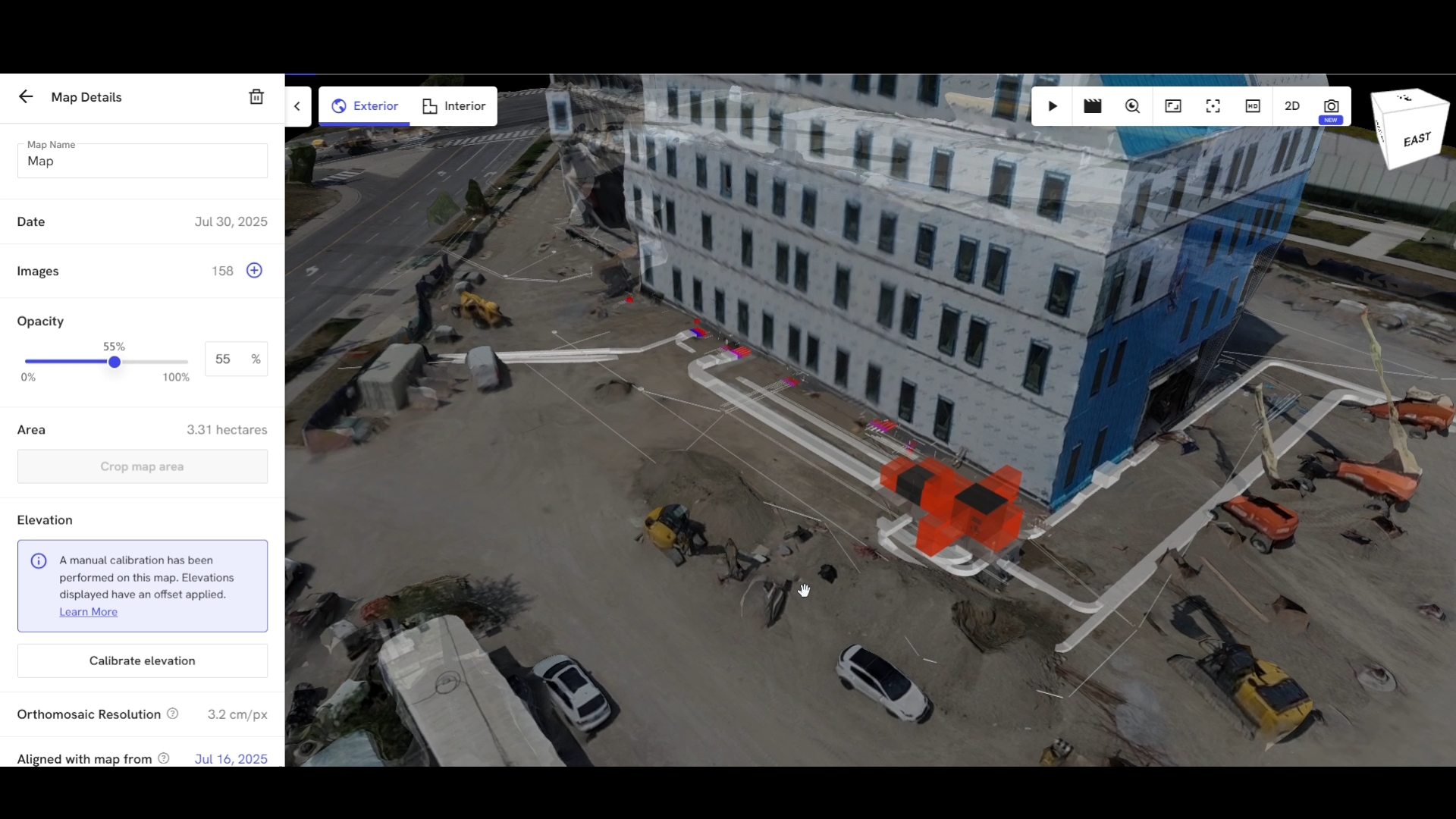
At the operational level, EllisDon’s ecosystem introduces several innovative workflows that transform how data is used on site. One of the most impactful is the overlay of Building Information Modelling (BIM) models with AI-powered site cameras and 360° reality capture. By comparing model expectations with real-time imagery, teams can automatically detect discrepancies, identify potential issues early, and intervene before problems escalate into rework or delays.
Drone-based surveys further enrich this environment by providing high-resolution aerial data linked to logistics planning and 4D simulations. These datasets introduce a “site-truth” layer that enhances sequencing, spatial planning, and stakeholder communication—particularly valuable in dense urban or fast-track project contexts.
To ensure reliability, EllisDon implemented dashboards for model health, issue tracking, and progress validation. These dashboards provide real-time visibility into data quality and construction status, supporting accountability across disciplines. Together, these tools form an integrated intelligence layer that enables proactive, rather than reactive, project management.
Measured Outcomes Across Live Projects
The ecosystem’s value has been demonstrated across multiple large-scale projects. Integrating 360° photo technology with 3D models enabled early identification of as-built deficiencies, allowing issues to be resolved before occupancy. On a downtown Toronto project, EllisDon measured the relationship between time invested in digital workflows and time saved, achieving an input/output ratio of 4.2. This was driven by automated coordination processes and in-house model enhancements that reduced manual effort.
Augmented reality integrations delivered similarly strong results. On a healthcare project in Ontario between late 2024 and early 2025, more than 1,000 deficiencies were identified through AR-based model reviews before construction began. These issues were logged directly into the BIM platform, eliminating manual documentation and preventing schedule impacts estimated at over one month.
AI-powered site cameras and drone footage have also transformed stakeholder engagement. In data center projects—where equipment delivery timelines are critical—these tools were adopted in all internal and owner-architect-contractor meetings, improving alignment and accelerating decision-making. To date, more than eleven projects with a combined value in the tens of billions of dollars have implemented components of the ecosystem.
Open Standards as a Strategic Foundation
Interoperability is foundational to EllisDon’s digital ecosystem. The framework is guided by ISO 19650 principles for information management, ensuring consistent governance across the project lifecycle. Open formats such as Industry Foundation Classes (ICF) enable model data to be exchanged seamlessly across dashboards, Augmented Reality (AR) viewers, and reality capture platforms, while BIM Collaboration Format (BCF) supports vendor-neutral issue tracking and collaboration.
EllisDon works closely with technology partners to ensure these standards are supported across AI analytics, 360° photography, AR overlays, and cloud-based dashboards. By prioritizing open standards, the ecosystem avoids vendor lock-in, reduces data silos, and ensures long-term usability of project information.
Reframing Best Practices Around Outcomes
Rather than centering digital strategy on specific tools, EllisDon’s approach reframes best practices around outcomes. The ecosystem is designed before procurement, allowing teams to define the value they seek—such as reduced rework or improved coordination—and then select technologies that support those goals.
This “underfitting” strategy avoids over-customization and protects projects from market volatility. It also supports clearer client communication, enabling teams to justify technology investments based on measurable benefits rather than technical novelty. By owning and structuring its data, EllisDon positions itself to leverage future AI capabilities while maintaining regulatory compliance across aviation, healthcare, and institutional environments.
Economic and Societal Value
Economically, the holistic digital ecosystem enhances EllisDon’s competitiveness by improving productivity and predictability without proportional increases in staffing. Standardized, connected workflows compress coordination cycles and reduce costly change-driven friction—critical advantages in a high-cost, resource-constrained market.
The ecosystem also supports innovation within the Canadian technology sector. By enabling interoperability, EllisDon creates opportunities for smaller North American startups to integrate their solutions, accelerating commercialization and generating high-skill jobs in software, data, and robotics.
Beyond economics, the ecosystem delivers broader societal benefits. Reduced rework and fewer site visits lower material waste, fuel use, and emissions. AI-assisted monitoring improves safety and job quality, while accessible digital workflows support workforce upskilling and inclusion.
Ultimately, EllisDon’s holistic digital ecosystem demonstrates how thoughtful integration—grounded in open standards and outcome-driven design—can transform construction delivery. It offers a scalable model for a more resilient, sustainable, and data-informed built environment.
Related Awards


