



Encoding Engineering Intelligence into the Digital Model
The Hidden Bottleneck in Steel Digital Delivery
Steel connection modeling sits at the intersection of engineering rigor and constructability. While it is essential for reaching Level of Detail (LOD) 400 and enabling fabrication-ready Building Information Modelling (BIM) deliverables, it has historically been one of the most labor-intensive and error-prone aspects of structural modelling. Each connection must reconcile structural calculations, fabrication constraints, procurement realities, and erection considerations, often across disconnected teams and tools.
At Canam, it became clear that improving steel digital delivery required more than faster drafting. The challenge was to rethink how engineering intent, calculation logic, and modelling geometry interact, and to do so in a way that could scale across projects without sacrificing precision or flexibility.
From Manual Translation to Intelligent Automation
The growing expectation for early LOD400 deliverables has placed new pressure on structural teams. Owners and contractors increasingly rely on highly detailed models earlier in the project lifecycle to support coordination, procurement, and construction planning. Yet the tools and workflows supporting steel connections have not evolved at the same pace.
Disconnected processes persist across the industry. Engineering knowledge is locked in calculation files, while 3D models remain largely geometric representations. This separation forces teams into linear handoffs rather than collaborative workflows, slowing delivery and increasing coordination overhead.
Automating steel connections presents an opportunity not only to save time, but to fundamentally improve quality and consistency. However, generic automation tools often fall short, producing geometry without understanding fabrication realities or erection constraints. The real challenge is not automation alone, but meaningful automation, where engineering intelligence directly informs the model.
EDX, the Engineering Data Exchange tool by Canam, was developed to meet this challenge by embedding engineering expertise into a repeatable, intelligent digital process.
Closing the Loop Between Calculation and Geometry
EDX bridges the gap between engineering calculations and 3D modeling through a tightly integrated workflow built around Tekla Structures. The process begins with an LOD300 Tekla model containing framing geometry and design intent. From there, structured inputs, such as loads, special requirements, and erection constraints, are extracted and processed through Canam’s internal engineering calculation tables.
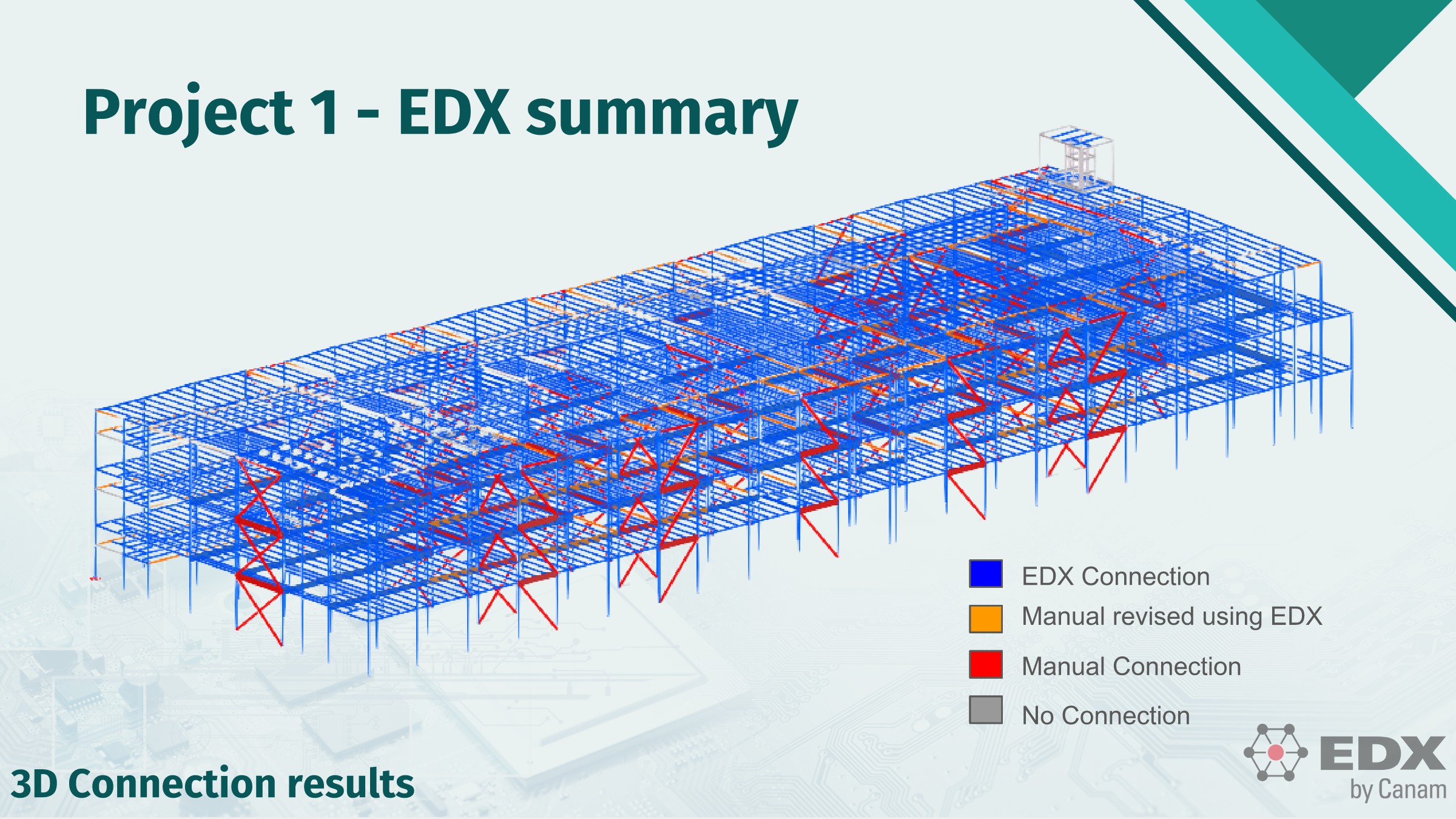
These calculation tools, refined over decades of practice, determine the appropriate steel connection configuration, accounting for bolt quantities, weld sizes, plate dimensions, and other fabrication-critical parameters. Rather than stopping at documentation, EDX feeds this calculated data directly back into the Tekla model, automatically generating complete LOD400 3D connection geometry.
What was once a fragmented, multi-step exchange becomes a continuous digital loop. Engineers no longer need to manually reinterpret calculations for modelling, and drafters receive fully formed, fabricable connections with embedded intelligence. The result is a model that reflects not just structural intent, but constructible reality.
A Tool Shaped by Practice, Not Theory
One of EDX’s defining strengths is its origin. Rather than developing a standalone platform or relying on complex Application Programming Interfaces (APIs), Canam built EDX around the real workflows of its engineering and drafting teams. The tool operates through structured data exchanges and calculation logic rather than custom programming, ensuring high relevance and ease of adoption.
This approach allows EDX to remain flexible and transparent. Connection logic is not hidden behind black-box automation, but grounded in familiar engineering tables and drafting practices. Teams can review, validate, and adapt outputs as needed, maintaining professional judgment while benefiting from automation.
Critically, EDX respects fabrication and erection constraints from the outset. Unlike generic BIM automation tools, it reflects the realities of shop processes and site conditions. This alignment ensures that generated connections are immediately usable for downstream activities, including detailing, procurement, and fabrication.
While EDX does not yet cover every possible connection type, its evolving library reflects a deliberate focus on high-value, repeatable conditions, those that benefit most from automation without oversimplification.
Advancing Toward “Model-as-Calculation”
EDX represents a conceptual shift in how digital models are understood. Rather than treating models as static representations of completed decisions, EDX enables a “model-as-calculation” approach, where engineering intent and logic are embedded directly into geometry.
This integration changes how teams collaborate. Engineers and drafters work in parallel rather than sequentially. Quality control shifts from checking manual translations to validating automated logic. Time previously spent on repetitive drafting tasks is redirected toward reviewing edge cases and optimizing solutions.
By encoding institutional knowledge into a system, EDX also supports consistency across projects. Connection standards are applied uniformly, reducing variability driven by individual interpretation. Over time, this creates a more resilient and scalable digital delivery model, one that retains expertise while reducing dependency on manual effort.
Measurable Impact Through Adoption
While formal benchmarks are still being developed, the impact of EDX is clear in practice. Teams using the tool report immediate improvements in speed, reliability, and consistency. Connections that once required significant manual drafting effort now appear fully formed in Tekla models, complete with embedded attributes.
One of the strongest indicators of success is adoption behavior. Engineering and drafting teams that have transitioned to EDX consistently express reluctance to return to previous methods. The workflow feels more intuitive, reduces coordination loops, and supports higher-quality outcomes.
Because connections are generated from centralized logic rather than individual interpretation, rework and time waste are reduced and review processes are streamlined. Coordination between engineering and drafting teams is simplified, as most connection-related decisions are already resolved within the model.
Open Outputs, Flexible Integration
Although EDX was developed without direct reliance on Tekla’s API, it remains fully compatible with open data exchange practices. The 3D connections and assemblies generated by EDX can be exported using the IFC format, supporting coordination with clients, consultants, and downstream platforms.
Connection data, including quantities, weld specifications, and material attributes, can also be exported through structured Excel or CSV files. This enables integration with estimating systems, procurement workflows, and project controls, ensuring transparency beyond the modeling environment.
This combination of internal intelligence and open outputs provides flexibility without compromising performance. EDX operates as a high-value internal tool while supporting broader project collaboration and data sharing.
Redefining Collaboration Between Disciplines
EDX replaces traditional handoff-based workflows with a live digital feedback loop between engineering and modeling. This shift has broader implications for how disciplines collaborate. Engineering intelligence is no longer locked in documents, and modeling is no longer a passive translation exercise.
As EDX continues to evolve, it offers a compelling model for the steel industry: one where automation supports, not replaces, professional judgment. By embedding expertise into systems, firms can reduce risk, improve constructability, and deliver higher-quality outcomes at scale.
The approach is inherently scalable. While EDX is tailored to Canam’s internal practices, the underlying concept, integrating calculation logic directly into modeling workflows, can inform broader industry innovation.
Productivity, Capacity, and Knowledge Retention
From an economic perspective, EDX delivers value across the steel delivery lifecycle. Reduced drafting time and fewer rework cycles translate into shorter lead times and more efficient use of skilled labor. As Canam applies EDX across more projects, these efficiencies compound, increasing overall project capacity without proportional increases in staffing.
EDX also supports knowledge retention. Rather than relying solely on individual expertise, connection logic becomes embedded within a system that can scale and evolve. This strengthens organizational resilience and supports training and onboarding of new professionals.
At an industry level, tools like EDX reinforce Canada’s leadership in steel construction innovation, demonstrating how digital delivery can enhance productivity while preserving engineering excellence.
Elevating Standards Through Intelligent Automation
By automating one of the most complex and repetitive aspects of steel design, EDX frees engineers and designers to focus on higher-value work, optimizing material efficiency, resolving site-specific challenges, and improving constructability. Over time, this contributes to reduced material usage, improved safety, and lower emissions through smarter design decisions.
More broadly, EDX demonstrates how digital tools can elevate, rather than diminish, professional practice. By aligning automation with engineering judgment, it fosters a collaborative, forward-thinking culture that supports both experienced practitioners and the next generation of professionals.
As EDX continues to mature, its influence may extend beyond Canam, helping to raise expectations for precision, integration, and intelligence in steel digital delivery. In doing so, it exemplifies the spirit of the Members Choice award: innovation grounded in practice, shaped by peers, and valued by those who use it every day.
Related Awards


