


Building Canada Differently: A National Roadmap for Industrialized Construction - Best in Innovation and Academic and Research Award Winner 2025


By
Building Canada Differently: A National Roadmap for Industrialized Construction
In collaboration with the University of Alberta and Cast Consultancy. Funded by the National Research Council (NRC)
A Construction Industry Under Pressure
Few industries are as deeply tied to Canada’s economic stability, social well-being, and climate commitments as construction. Accounting for roughly seven percent of national GDP and employing more than 1.4 million Canadians, the sector shapes how—and how well—the country grows. Yet despite its scale and importance, construction is struggling to keep pace with rising expectations.
For decades, productivity growth in Canadian construction has remained largely stagnant. At the same time, the industry faces an aging workforce, escalating costs, increasing regulatory complexity, and an unprecedented demand for housing and infrastructure. Estimates suggest Canada will face a housing shortfall of 3.5 to 4.4 million homes by 2030, with particularly acute impacts in remote, northern, and underserved communities.
These pressures are unfolding alongside urgent climate imperatives. Buildings and construction remain major contributors to greenhouse gas emissions, and traditional construction methods are increasingly misaligned with Canada’s emissions reduction targets and sustainability goals.
Together, these forces have created a defining moment for the industry—one that demands not incremental improvement, but structural change.
Industrialized Construction: Promise Without Scale
Industrialized Construction (IC)—a broad term encompassing off-site construction, prefabrication, modularization, automation, and digitally enabled manufacturing—has emerged globally as a compelling response to the challenges facing construction. By shifting work from unpredictable site conditions to controlled manufacturing environments, IC can significantly improve productivity, reduce waste, shorten schedules, and lessen dependence on scarce on-site labour.
In theory, Canada is well positioned to benefit from this shift. The country has strong academic institutions, advanced manufacturing capacity, and a growing number of innovative firms already applying IC methods. In practice, however, adoption has been fragmented and uneven.
While pilot projects and regional successes exist, they have not coalesced into a national movement. Stakeholders frequently cite inconsistent regulations, misaligned financing and insurance models, a lack of standardized terminology, and limited coordination between research, policy, and industry as persistent barriers. As a result, the full benefits of Industrialized Construction remain unrealized.
What has been missing is not innovation, but alignment.
The Missing Link: A National Strategy Built by Industry
Recognizing this gap, the University of New Brunswick’s Off-site Construction Research Centre (OCRC), in collaboration with the University of Alberta and Cast Consultancy and funded by the National Research Council (NRC), led the development of a national Research and Development (R&D) Roadmap for Industrialized Construction. The goal was not to prescribe a single solution, but to create a shared framework capable of aligning diverse actors around common priorities.
Central to the roadmap’s development was an emphasis on industry-led insight. Rather than relying solely on academic or policy-driven perspectives, the project engaged more than 120 stakeholders across the construction value chain through literature reviews, workshops, interviews, and a national survey. Participants included manufacturers, builders, developers, policymakers, regulators, insurers, financiers, educators, and researchers from across Canada.
This engagement revealed both the breadth of innovation already underway and the extent to which it remains constrained by systemic fragmentation. The roadmap emerged as a response to this reality: a practical, consensus-driven strategy designed to translate innovation into scalable, repeatable practice.
From Fragmentation to Framework
At the heart of the roadmap is recognition that Industrialized Construction cannot be advanced through isolated initiatives alone. It requires coordinated action across policy, procurement, finance, workforce development, and research.
To this end, the roadmap identifies six interdependent areas that must evolve in parallel if IC is to scale nationally:
- Regulatory and policy alignment across jurisdictions
- Procurement models that reward value rather than lowest cost
- Financial and insurance mechanisms suited to off-site production
- Awareness, education, and workforce capability development
- Methods to quantify national capacity and performance
- Coordinated research, data sharing, and knowledge transfer
Within these areas, the roadmap outlines 28 prioritized initiatives, each supported by defined stakeholders, implementation horizons, and performance metrics. Importantly, these initiatives were not imposed from above; they were refined and ranked through stakeholder consensus, ensuring relevance to real-world conditions.
The result is a framework that moves beyond aspiration, offering a clear sequence of actions that can be taken collectively by industry, government, and academia.
Reimagining How Innovation Is Governed
One of the roadmap’s most consequential contributions is its proposed governance model for Industrialized Construction research and innovation. Stakeholders consistently identified the absence of a national coordinating body as a barrier to progress, leading to duplication of effort, inconsistent data, and missed opportunities for collaboration.
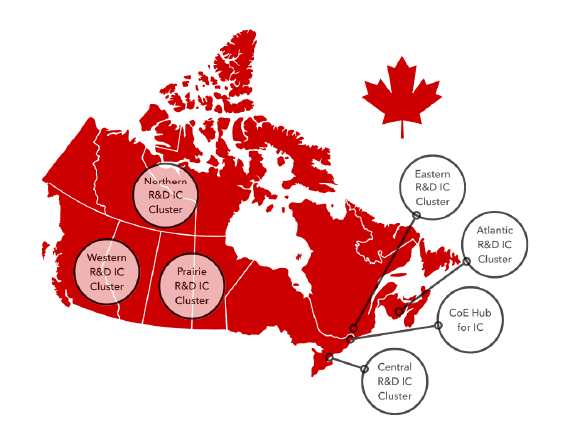
In response, the roadmap proposes a “hub and spoke” model anchored by the NRC. Under this approach, a new Centre of Excellence (CoE) for Industrialized Construction would serve as the national hub, responsible for coordinating research priorities, standardization efforts, and data collection.
Regional research clusters—built around universities, innovation centres, and industry partners—would act as the spokes, driving localized experimentation and implementation. This structure allows regional strengths to flourish while ensuring that insights, data, and best practices feed into a unified national system.
By connecting local innovation to national strategy, the model creates the conditions for scale without sacrificing regional relevance.
Speaking the Same Language: The Importance of Standards and Metrics
Another recurring theme across stakeholder engagement was the absence of a shared language for Industrialized Construction. Without consistent definitions, classifications, and performance metrics, aligning regulation, financing, procurement, and insurance becomes exceedingly difficult.
To address this foundational issue, the roadmap calls for the adoption of a national IC categorization framework, informed by international models such as the United Kingdom’s Modern Methods of Construction (MMC). This framework would establish common terminology and typologies, enabling clearer communication across jurisdictions and disciplines.
Complementing this is the proposed development of a Pre-Manufactured Value (PMV) toolkit—a standardized type of methodology to quantify the off-site content and benefits of construction projects. Such a quantifiable index would enable consistent benchmarking, improve risk assessment for lenders and insurers, and support value-based procurement decisions.
While the roadmap does not directly implement technical data standards, it strongly emphasizes the need for open, interoperable data aligned with global best practices such as OpenBIM. The NRC’s proposed Centre of Excellence would play a central role in advancing open data protocols, supporting national case studies, and collaborating with Statistics Canada to develop shared, anonymized datasets.
From Strategy to Impact
Although the roadmap itself is not a commercial product, its impact lies in the downstream value it enables. One of the project’s key findings was that more than 60% of stakeholders had experienced persistent barriers to IC adoption, particularly in regulation, financing, and workforce readiness.
By directly targeting these constraints, the roadmap positions the sector for measurable gains in productivity, cost efficiency, and delivery speed. Improved coordination and standardization can reduce project risk, accelerate approvals, and make Industrialized Construction a more viable option for a broader range of projects.
Equally important, the roadmap establishes a replicable model for how Canada can approach construction innovation more broadly—treating it as a system-level challenge rather than a collection of disconnected technical advancements.
Economic Renewal Through Industrialized Building
The economic implications of scaling Industrialized Construction are substantial. By improving productivity in one of Canada’s largest industries, IC has the potential to generate long-term gains in GDP and competitiveness. Faster, more predictable construction delivery benefits both public infrastructure investment and private development, reducing costs and improving outcomes.
The roadmap also supports workforce renewal at a critical moment. With hundreds of thousands of construction workers approaching retirement, IC offers pathways to new types of employment in advanced manufacturing, digital design, automation, and data analysis. These roles are often safer, more inclusive, and more attractive to younger and more diverse workers, strengthening the sector’s long-term resilience.
A Broader Vision for Canada’s Built Environment
Beyond economics, the roadmap speaks to broader societal goals. For example, by enabling faster, higher-quality, and more sustainable housing delivery, Industrialized Construction directly supports efforts to address Canada’s housing crisis. Off-site and prefabricated methods can reduce material waste by up to 90 percent and deliver buildings with improved energy performance, aligning with Canada’s emissions reduction commitments.
The roadmap also emphasizes inclusive growth. Through regional research clusters and targeted skills development, it supports innovation in remote and underserved communities, ensuring that the benefits of modernization are not confined to major urban centres.
Aligning Innovation with Purpose
The National R&D Roadmap for Industrialized Construction represents a decisive step toward a more coordinated, productive, and future-ready construction sector in Canada. By aligning industry, academia, and government around a shared framework, it transforms innovation from isolated effort into collective momentum.
At a time when Canada must build more, faster, and better—while reducing emissions and strengthening social equity—this roadmap provides both direction and structure. It offers not just a vision of what Industrialized Construction can achieve, but a credible pathway to make it real.
In doing so, it lays the foundation for a construction industry capable of meeting the demands of the present while building resilience for generations to come.
Related Awards


